
Table of Contents
ToggleWhen gaming writers talk about pivotal moments that changed everything, they’re often discussing a single decision, a clutch play, or a meta shift that redefined how a game is played. History works much the same way. The Stones River Battlefield, fought in Tennessee from December 30, 1862, to January 2, 1863, represents one of those rare inflection points where the outcome of an entire conflict hung in the balance. For those interested in Civil War history, whether approaching it through strategy games, historical simulations, or pure academic curiosity, understanding Stones River is essential. This battle didn’t just shift Union fortunes: it demonstrated the brutal calculus of attrition warfare and the consequences of split-second strategic decisions. We’re diving into the full breakdown of this battle, the commanders who shaped its outcome, and what makes it historically significant today.
Key Takeaways
- Stones River Battlefield was a strategically pivotal Civil War engagement (December 30, 1862–January 2, 1863) that shifted Union momentum in the Western Theater despite being tactically inconclusive.
- The battle resulted in approximately 24,000 casualties out of 80,000 soldiers engaged—a devastating 30% casualty rate—making it one of the war’s costliest conflicts in human terms.
- Union General William Rosecrans’ decision to pivot his army and establish a defensible position prevented the catastrophic collapse that Confederate General Braxton Bragg sought, ultimately forcing Confederate withdrawal.
- Stones River demonstrated that preparation, intelligence, and terrain awareness were as crucial as tactical audacity, reshaping how military strategists viewed command decisions under pressure.
- Confederate failure to achieve victory in Stones River ended hopes of regaining the initiative in the Western Theater and enabled subsequent Union advances that threatened vital Confederate supply lines.
- Stones River National Battlefield today preserves 570 acres of the original battlefield, offering visitors and history enthusiasts direct engagement with the ground where this crucial inflection point unfolded.
What Is Stones River Battlefield and Why Does It Matter?
Stones River Battlefield sits near Murfreesboro, Tennessee, and marks the site of one of the Civil War’s most consequential yet underrated engagements. Unlike more famous battles like Gettysburg or Antietam, Stones River didn’t produce the narrative of a clear Union victory or Confederate triumph, it was messier, harder to parse, and far more costly in human terms.
The battle involved roughly 80,000 soldiers total: around 43,000 Union troops under Major General William Rosecrans facing 38,000 Confederates commanded by General Braxton Bragg. Over the course of four days, approximately 24,000 men became casualties, killed, wounded, captured, or missing. That’s a casualty rate that approaches 30% of the total force engaged, comparable to some of the bloodiest moments in the entire war.
Why does this matter? Because Stones River achieved something that shifted the entire strategic landscape of the Western Theater. Though tactically inconclusive (both sides claimed victory), it was a strategic Union success that stopped Confederate momentum in the heartland. For a Union cause that desperately needed wins in late 1862, this battle proved the army hadn’t been broken by earlier defeats. Bragg’s withdrawal from Middle Tennessee opened the door to subsequent Union advances, eventually threatening vital Confederate supply lines and territory.
Historical Context: The Battle That Shifted the War
The Prelude to Conflict
By the end of 1862, the American Civil War had settled into a grinding war of attrition. The early Confederate victories and romantic notions of a quick war had evaporated. The Union had invested enormous resources trying to break the Confederacy in the Eastern Theater under leaders like McClellan and Pope, with mixed results. The Western Theater, but, represented a different kind of opportunity: it was more open, less entrenched, and offered clearer paths to strategic advantage.
Early 1862 brought Union victories at Shiloh and New Orleans, along with the capture of Nashville, which boosted Northern morale significantly. By late autumn, though, Confederate forces under Bragg had recovered ground and seemed poised to reclaim Middle Tennessee. The Union Army of the Cumberland, under Rosecrans (who’d recently replaced Don Carlos Buell), faced mounting pressure to strike back. Inaction invited criticism and allowed Confederate momentum to build. Both commanders knew that whoever seized the initiative would dictate the campaign’s trajectory.
Union and Confederate Strategic Positions
When both armies began moving toward Murfreesboro in late December, neither commander had perfect intelligence about the other’s dispositions. Rosecrans aimed to move south from Nashville and push the Confederates out of Middle Tennessee for good. Bragg, meanwhile, hoped to catch the Union army mid-march and inflict a decisive defeat before it could consolidate.
The terrain around Stones River favored neither side exclusively. The river itself, actually more of a creek in places, provided natural barriers and crossing points that both commanders had to carefully consider. Bragg positioned his army west of the river, while Rosecrans approached from the northwest. The Confederate plan was aggressive: launch a dawn assault on December 30th targeting the Union right flank, with the hope of rolling up the entire Federal line and forcing a rout.
Rosecrans, but, had already detected Confederate movements and was prepared for an attack. He positioned strong reserves and artillery to respond to a flanking assault. What followed was one of those rare moments where both commanders anticipated roughly the same sequence of events, and then had to execute under real-time, chaotic conditions where nothing goes exactly according to plan.
A Minute-By-Minute Timeline of the Battle
Day One: December 30, 1862
The battle erupted at dawn on December 30, 1862, when Confederate forces struck exactly where Rosecrans had expected: the right flank of the Union army, held by General Alexander McDowell McCook. The assault came with overwhelming force and tactical audacity. Confederates poured through the darkness and morning mist, shattering the Federal right with a series of coordinated attacks.
What makes this opening crucial is that it almost worked. McCook’s division collapsed, and the Union right began folding backward. Confederate General Patrick Cleburne, commanding a division on Bragg’s left, executed the flank attack with textbook precision. Union regiments either retreated or faced capture. For a moment, Bragg believed he was on the verge of the breakthrough he’d sought.
But Rosecrans made a critical decision. Rather than commit to a defensive line where his right flank could be repeatedly encircled, he shifted his entire army’s orientation. Union forces pivoted to refuse the right flank, essentially anchoring it on Stones River and wheeling the army to face the Confederate assault from a more defensible posture. This maneuver, executed in real-time during active combat, prevented the catastrophic collapse Bragg had hoped to achieve.
Artillery played a defining role on this first day. Union batteries, carefully positioned by reserve commanders, poured fire into Confederate columns. The combination of disciplined artillery work and the tactical adjustment bought Rosecrans time to consolidate his position. By day’s end, though the Union right had been badly mauled, the army remained intact and had established a new defensive line.
Day Two and Three: The Turning Point
December 31 saw continued heavy fighting, with the Confederates pressing the attack against the Union center. Bragg remained convinced that one more sustained assault would break the Federal line entirely. He threw divisions forward against fortified positions, trying to achieve the breakthrough that had eluded him on day one.
The battle became a grinding, brutal affair centered on areas like the Round Forest, where Union troops held a wooded position against repeated Confederate assaults. Artillery exchanges reached an intensity that rivaled any moment in the Western Theater. Casualties mounted horrifically on both sides. Whole regiments were shattered. The air filled with smoke, and communication between commanders and units broke down repeatedly.
By the evening of December 31, something crucial had happened: the Confederate attacks, though fierce, had failed to achieve a decisive breakthrough. Bragg had committed his reserves, and they’d made progress but not victory. Rosecrans, seeing the strategic opportunity slipping away even though heavy losses on his side, planned a fresh attack for the next day.
But, neither commander realized that January 1, 1863, would be the day the battle’s trajectory reversed decisively. On the morning of the new year, a Union cavalry force under Colonel John Minty discovered that Confederate reinforcements had failed to arrive, and a gap had opened in Bragg’s line. Simultaneously, Rosecrans launched an assault that, while not particularly well-coordinated, broke Confederate resolve.
Bragg, who’d fought tenaciously for two and a half days believing victory was within reach, suddenly faced the prospect of being outflanked and potentially cut off from his supply line. Against the counsel of some subordinates who believed they could continue fighting, Bragg decided to withdraw to the south. The decision was made: after inflicting terrible casualties on both sides, the Union had retained the field. The battle wasn’t over on paper until January 2, but the Confederate withdrawal was the decisive moment.
Key Figures and Military Leaders
Union General William Rosecrans and His Strategy
William Starke Rosecrans wasn’t the flashiest Union general. He lacked the reputation-making victories that would define figures like Grant or Sherman. But he was a thoughtful, meticulous commander who understood logistics and defensive positioning better than most. Before Stones River, he’d earned mixed reviews, victories at Iuka and Corinth, but also the perception of being overly cautious.
Rosecrans’ preparation for Stones River demonstrated how preparation and intelligence work could shape a battle’s outcome. He’d scouted the terrain thoroughly, positioned reserves strategically, and, crucially, anticipated Bragg’s intentions. When the Confederate assault came, it found not a surprised army scrambling to respond, but a commander who’d already mentally rehearsed several contingency scenarios.
His critical decision came in those first hours on December 30: pivot the army to a defensive posture rather than try to hold the original line. This decision, made under intense pressure and with incomplete information, prevented the catastrophic collapse that might have given Bragg the victory he sought. Rosecrans also managed his artillery effectively, concentrating it at critical points to break up Confederate attacks. After the battle, even Confederate observers acknowledged that Rosecrans had fought intelligently and that his tactical positioning had been sound.
Confederate General Braxton Bragg’s Approach
Braxton Bragg remains one of the Civil War’s most controversial figures. He was aggressive, sometimes recklessly so, and he maintained rigid discipline that alienated subordinates. At Stones River, Bragg displayed both his strengths and weaknesses.
His aggressive opening assault on December 30 showed tactical boldness. He recognized the opportunity to strike a retreating army mid-concentration and moved decisively to exploit it. The plan itself was sound: mass force against a specific point, break the Union flank, and achieve a breakthrough before reinforcements could arrive. For many generals, this would be the right call.
Where Bragg faltered was in his inability to adapt when the initial plan went awry. When Rosecrans’ pivot prevented the complete collapse of the Union right, Bragg should have reassessed. Instead, he committed additional forces to frontal assaults that, while fierce and tactically impressive, couldn’t overcome an increasingly consolidated Federal defense. His stubborn pursuit of victory, when a more strategic withdrawal might have preserved Confederate strength for future operations, cost him dearly.
By January 1, Bragg’s reinforcements hadn’t materialized as expected, Confederate units were exhausted from three days of continuous assault, and Rosecrans showed signs of preparing a fresh attack. At that point, Bragg’s decision to withdraw was militarily sound, but it also meant accepting that his original strategic objective, a decisive Confederate victory, had failed.
The Aftermath and Long-Term Impact
Casualties and Human Cost
The numbers tell the story with brutal clarity. Out of roughly 80,000 soldiers engaged, nearly 24,000 became casualties. The Union suffered approximately 12,000 casualties (1,633 killed, 7,033 wounded, 3,623 captured or missing). The Confederacy lost around 12,000 as well (1,294 killed, 5,800 wounded, 4,000 captured or missing). These figures, while slightly different from other accounts depending on the source, underline the battle’s savage intensity.
For context, a 30% casualty rate approaching battle engagement levels that modern militaries consider catastrophic. Regiments that entered the battle with 400 or 500 men sometimes left with fewer than 100 combat-effective soldiers. Hospitals across Tennessee filled with wounded. Burial details worked for days after the fighting stopped. The human cost of Stones River was so severe that both armies needed weeks to recover and regroup.
One particularly gruesome aspect was what happened to the wounded during the fighting. Several regiment accounts describe men left on the frozen ground during the winter nights, many freezing to death before medical teams could retrieve them. The famous “Hazen’s Brigade” held the Round Forest position against assault after assault, and though they held, the human price was extraordinary. Entire companies of men who’d marched into battle were virtually erased.
Political and Military Consequences
For the Union, Stones River arrived at a moment of desperate strategic need. 1862 had been a year of disappointment. Even though Northern advantages in population, industrial capacity, and resources, the Confederacy had held its own and often gained ground. When Stones River resulted in Confederate withdrawal, Northern newspapers and politicians seized on it as proof that the Union army could defeat the South.
Lincoln himself recognized the importance of the battle, particularly its timing on the heels of the Emancipation Proclamation. The President needed both a military victory and moral clarity. Stones River provided one half of that equation, allowing him to present the war as one the Union was winning militarily.
For the Confederacy, Stones River was a missed opportunity with serious strategic implications. Bragg’s failure to crush Rosecrans meant that Union forces remained in Middle Tennessee, controlling the critical Nashville area. This gave the Union a platform from which to launch subsequent operations deeper into the South. Bragg’s retreat also damaged confidence in his leadership, though he retained his command even though considerable criticism from subordinates.
Militarily, Stones River ended Confederate hopes of regaining the initiative in the Western Theater. The campaign that followed saw Union forces pressing deeper into the South, eventually threatening vital supply and communication lines. While the Eastern Theater would continue producing dramatic reversals and Confederate victories under Lee, the Western Theater increasingly favored Union strategy and logistics. Stones River represented the moment when that trend became irreversible.
Exploring Stones River National Battlefield Today
Visitor Experience and Educational Opportunities
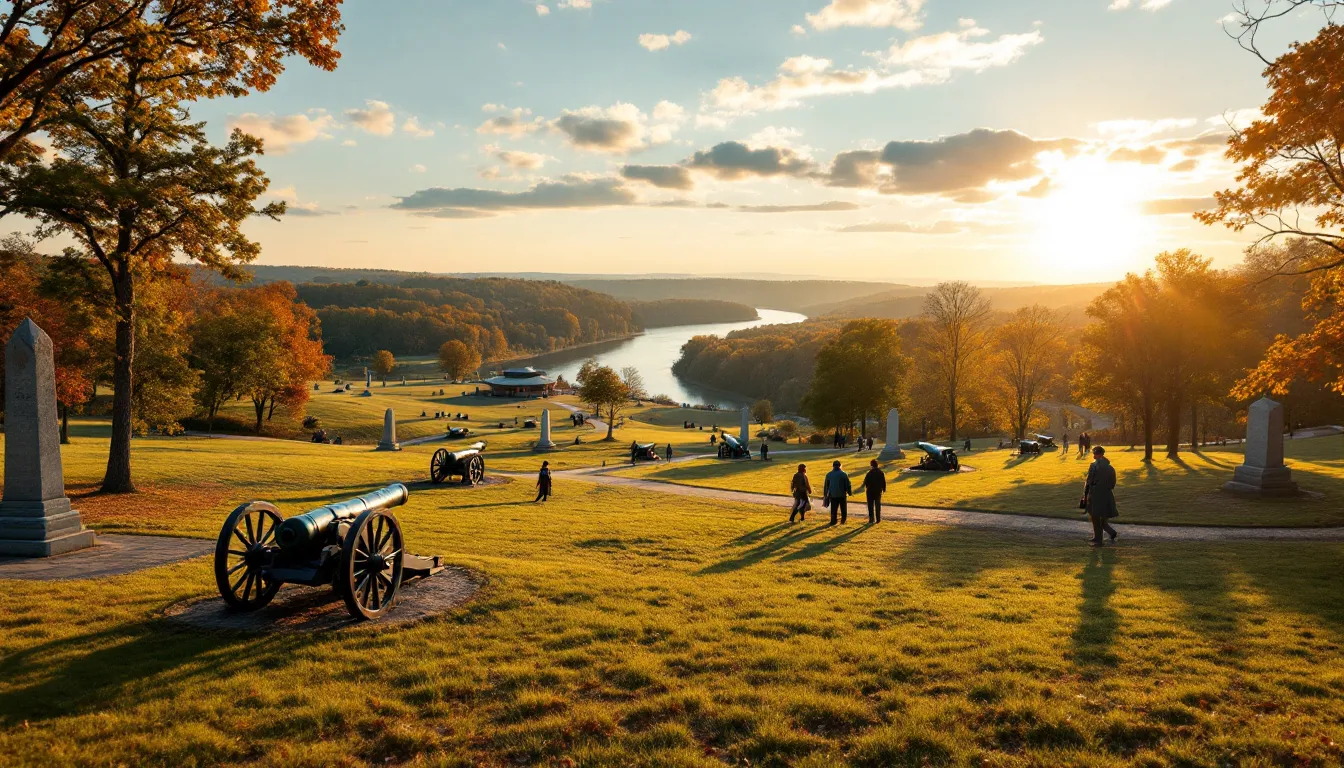
Today, Stones River National Battlefield operates as both a historical site and an educational resource. The park encompasses roughly 570 acres of the original battlefield, preserved as a monument to the soldiers who fought there. Walking the grounds, visitors can follow interpretive trails that explain troop movements, point out key positions, and contextualize the decisions made by commanders on both sides.
The visitor center houses artifacts, exhibits, and detailed maps that help people understand how the battle unfolded. Rangers provide guided tours during peak seasons, offering narratives that bring the historical events to life. For students of military strategy, whether studying history academically or exploring it through gaming contexts, the physical site offers tangible insight into how terrain, positioning, and logistics shaped tactical decisions.
The National Park Service has done substantial work reconstructing key positions and monuments. Cannon placements mark artillery positions. Stone and iron monuments dedicated to individual regiments, divisions, and states dot the landscape. For anyone serious about understanding Civil War tactics and strategy, visiting Stones River provides a firsthand perspective impossible to gain from reading accounts alone.
Gamers interested in historical strategy, whether playing games like Total War or Civilization’s scenarios, or exploring the historical guides available on gaming sites, will find the physical site and interpretive materials valuable for understanding how historical decisions actually played out in real terrain.
Preservation Efforts and Historical Significance
Stones River National Battlefield represents an ongoing commitment to historical preservation. The site was established as a national battlefield park in 1927, making it one of the earlier Civil War preservation efforts. But, preservation isn’t static: modern challenges like urban expansion, traffic infrastructure, and environmental pressures require constant attention.
The National Park Service has worked with local communities to protect viewsheds, the visual perspectives from key positions, to maintain the historical integrity of the landscape. They’ve also collaborated with archaeological teams to uncover artifacts and better understand daily life for soldiers at Stones River. Recent excavations have revealed everything from personal items to military equipment, providing texture to the historical narrative.
Historically, Stones River often received less attention than more famous Civil War battles, partly because it wasn’t a clear-cut Union or Confederate victory and partly because dramatic finales appeal more to popular imagination. Modern historians have worked to elevate Stones River’s significance, arguing it was actually more strategically important than more celebrated engagements. The battlefield’s preservation matters because understanding this battle changes how people view the entire Civil War’s progression.
For strategy enthusiasts, especially those who engage with historical content through gaming or academic study, the preservation of Stones River National Battlefield ensures that future generations can physically engage with the historical ground. You can stand where Cleburne’s division launched their assault, walk through the Round Forest where regiments held against repeated attacks, and actually comprehend the challenges of coordinating military movements across broken terrain. Modern game designers and historical simulators often consult preserved battlefields to enhance authenticity, and sites like Stones River provide crucial reference material.
Researchers exploring Civil War tactics and strategy often turn to Civil War scholarship and analysis to deepen their understanding of how commanders like Rosecrans and Bragg approached problem-solving under extreme pressure. The combination of preserved ground, archival materials, and scholarly analysis creates a comprehensive picture of what made Stones River historically pivotal.
Conclusion
Stones River Battlefield represents a crucial inflection point in American Civil War history. It wasn’t the flashiest battle, and it wasn’t a decisive tactical triumph for either side, but it was strategically momentous. The Union’s ability to hold the field and force Confederate withdrawal shifted the Western Theater’s momentum toward Union advantage permanently.
Understanding Stones River requires grappling with the messy realities of historical warfare: incomplete information, contingency decisions made in real-time, logistics and positioning that matter as much as tactical audacity, and the human cost of those decisions. Both Rosecrans and Bragg made reasonable strategic choices based on what they knew: the outcome hung on execution, morale, and luck as much as brilliant strategy.
For those interested in military history, Civil War scholarship, or the strategic decisions that shaped American history, Stones River offers profound lessons. The battle demonstrates why preparation, intelligence, and flexibility matter. It shows how terrain shapes possibilities. It illustrates the gap between a commander’s hopes and reality. And it reminds us of the human cost, 24,000 casualties out of 80,000 soldiers engaged, that follows from these high-stakes decisions.
Whether exploring Civil War history through direct study, visiting the preserved battlefield near Murfreesboro, or encountering it in historical strategy games and simulations, Stones River merits serious engagement. It’s a battle that shaped the Civil War’s trajectory and deserves recognition as one of the conflict’s defining moments. The soldiers who fought there, both Union and Confederate, deserve to be remembered not as footnotes to more famous battles, but as participants in one of history’s turning points. Resources like the comprehensive gaming and historical guides available at Rock Paper Shotgun can help context beyond traditional academic sources.


